
Eleven Rings by Phil Jackson
On leadership...
Effective coaching and leadership are not a paint-by-numbers process, a checklist, or something mechanical.
Sometimes the best thing you can do as a leader is to get out of the way and let players and team members figure things out for themselves.
“Most players are used to letting their coach think for them. When they run into a problem on the court, they look nervously over at the sidelines expecting coach to come up with an answer. Many coaches will gladly accommodate them. But not me. I’ve always been interested in getting players to think for themselves so that they can make difficult decisions in the heat of battle.”
Look beyond the skill set and work on improving the person, not just the job.
- “My approach was always to relate to each player as a whole person, not just as a cog in the basketball machine. That meant pushing him to discover what distinct qualities he could bring to the game beyond taking shots and making passes. How much courage did he have? Or resilience? What about character under fire?”
Provide opportunities for everyone on the team to contribute. Dissension happens from the lower ranks when team members aren’t able to be part of the team.
- “Foster an environment in which everyone played a leadership role, from the most unschooled rookie to the veteran superstar. If your primary objective is to bring the team into a state of harmony and oneness, it doesn’t make sense for you to rigidly impose your authority.”
- “One of the hardest jobs of a coach is keeping the role players from undermining team chemistry… My strategy was to keep the backups as engaged as possible in the flow of the game.”
On compassion…
As a leader, it’s important to understand the goals and fears of team members.
- “Compassion is a word not often bandied about in locker rooms. But I’ve found that a few kind, thoughtful words can have a strong transformative effect on relationships, even with the toughest men on the team.”
- “Most players live in a state of constant anxiety, worrying about whether they’re going to be hurt or humiliated, cut or traded, or, worst of all, make a foolish mistake that will haunt them for the rest of their lives.”
On preparation…
Jackson worked to prepare his athletes in practice so that they would be ready for adversity during games and under the lights.
- “Once I had the Bulls practice in silence; on another occasion I made them scrimmage with the lights out. I like to shake things up and keep the players guessing. Not because I want to make their lives miserable but because I want to prepare them for the inevitable chaos that occurs the minute they step onto a basketball court.”
On being the bad guy…
Leaders must have a hard edge and be willing to use it when necessary.
Just because Jackson’s approach seemed soft and emphasized vulnerability, he wasn’t scared to come down on players, even if the stick he used was different. With the Bulls, he would set-up scrimmages with lopsided teams and not call any fouls on the weaker team, which drove his superstar, Michael Jordan, who hated to lose, up the wall.
- “This scheme used to drive Michael nuts because he couldn’t stand losing, even though he knew the game was rigged.”
He sat down with Luke Walton after coming down hard on him. He knew that Walton was looking to being a coach himself one day.
- “Coaching isn’t all fun and games. Sometimes no matter how nice a guy you are, you’re going to have to be an asshole. You can’t be a coach if you need to be liked.”
On the process…
Elite coaches and players often talk about valuing the process. Mastering the craft and remaining present. Prepare as best you can and let go of the outcome or result.
- “I know that being fixated on winning (or more likely, not losing) is counterproductive, especially when it causes you to lose control of your emotions. What’s more, obsessing about winning is a loser’s game: The most we can hope for is to create the best possible conditions for success, then let go of the outcome. The ride is a lot more fun this way.”
Focus on the process and the journey and the ring will take care of itself.
- “At the start of every season I encouraged players to focus on the journey rather than the goal. What matters most is playing the game the right way and having the courage to grow, as human beings as well as basketball players. When you do that, the ring takes care of itself.”
- “There’s a Zen saying I often cite that goes, ‘Before enlightenment, chop wood, carry water. After enlightenment, chop wood, carry water.’ The point: Stay focused on the task at hand rather than dwelling on the past or worrying about the future.”
On using meditation…
Meditation helped to clear Jackson’s mind. By clearing the inner chatter he was better prepared to deal with the exterior stuff.
- “It took me years to still my busy mind, but in the process I discovered that the more aware I became of what was going on inside me, the more connected I became to the world outside. I became more patient with others and calmer under pressure—qualities that helped me immensely when I became a coach.”
On using systems…
Having a good system allows criticism and accountability to flourish, especially with teams that have a lot of ego. When discussing the Triangle offense, developed by Bulls assistant coach Tex Winter, Jackson found the ball-sharing a natural corollary to the system’s ability to spread out accountability.
- “One thing I liked about Tex’s system, from a leadership perspective, was that it depersonalized criticism. It gave me the ability to critique the players’ performance without making them think I was attacking them personally. Pro basketball players are highly sensitive to criticism because almost everything they do is judged on a daily basis by coaches, the media, and just about anyone who owns a TV set.”
When under tremendous stress and pressure, a system is something you can lean on to maintain performance.
- “It gave the players something to fall back on when they were under stress… All they had to do was play their part in the system, knowing that it would inevitably lead to good scoring opportunities.”
A good system also gives you clarity and purpose.
- “The system also gave players a clear purpose as a group and established a high standard of performance for everyone.”
On change…
Groups, people, and things change. Improvisation is crucial for continued success. You can stick to the general things that got you success in the first place, but relying on a paint-by-numbers template gets old. The competition gets smarter. Team members change. What worked yesterday, doesn’t always work today.
- “The mistake that championship teams often make is to try to repeat their winning formula. But that rarely works because by the time the next season starts, your opponents have studied all the videos and figured out how to counter every move you made. The key to sustained success is to keep growing as a team. Winning is about moving into the unknown and creating something new.”
Jackson compares leadership to a moment in Indiana Jones, when Indy is asked what he is going to do next. “I don’t know, I’m making it up as I go along.”
- “It’s an act of controlled improvisation, a Thelonious Monk finger exercise, from one moment to the next.”
Circle of Love
The Zen Circle is a symbol of life, and of wellbeing. Its creation is underpinned by the theories of meditation and mindfulness.
In the book Phil describes that in order to achieve greatness as a team, a bonding around a circle of love must be built.
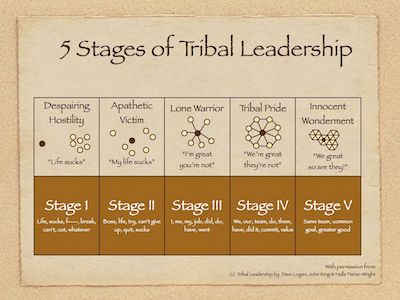
Tribal Leadership - 5 Stages of a Tribe
THE JACKSON ELEVEN
The basic principles of mindful leadership that Phil evolved over the years to help transform disorganised teams into champions.
1. LEAD FROM THE INSIDE OUT
"Some coaches like to run with the lemmings."

We should not fixate on studying others and what is the next shiny new technique.
Learn who you are as a leader and apply every aspect of what you are. Do not model yourself from what you see in others. Start with who you are at the core. You will be a much more authentic leader.
The more you speak from your heart, the more you will be respected. Repeating adages and sayings from others wears the ones you lead and they stop believing you.
2. BENCH THE EGO

I’ve taken a different tack. After years of experimenting, I discovered that the more I tried to exert power directly, the less powerful I became. I learned to dial back my ego and distribute power as widely as possible without surrendering final authority
@Ryan Holiday - Ego is the Enemy by Ryan Holiday
If your primary objective is to bring the team into a state of harmony and oneness, it doesn’t make sense for you to rigidly impose your authority.
Dialing back the ego doesn’t mean being a pushover.
That’s a lesson I learned from my mentor, former Knicks coach Red Holzman, one of the most selfless leaders I’ve ever known. Once when the team was flying out for a road trip, a player’s boom box started blaring some heavy rock. Red went over to the guy and said, “Hey, do you have any Glenn Miller in your mix?” The guy looked at Red as if he were out of his mind. “Well, when you get some, you can play a little of my music and a little of yours. Otherwise, shut that damn thing off.” Then Red sat down next to me and said, “You know, players have egos, but sometimes they forget that coaches have egos too.”
3. LET EACH PLAYER DISCOVER HIS OWN DESTINY
One thing I’ve learned as a coach is that you can’t force your will on people. If you want them to act differently, you need to inspire them to change themselves.
4. THE ROAD TO FREEDOM IS A BEAUTIFUL SYSTEM
You need a good system that stimulates people to follow the process but also one that does not depend on your team's stars to solve everything.
With the triangle you can’t stand around and wait for the Michael Jordans and Kobe Bryants of the world to work their magic. All five players must be fully engaged every second—or the whole system will fail. That stimulates an ongoing process of group problem solving in real time, not just on a coach’s clipboard during time-outs. When the triangle is working right, it’s virtually impossible to stop it because nobody knows what’s going to happen next, not even the players themselves.
5. TURN THE MUNDANE INTO THE SACRED
It's important to make certain things taken for granted as a little more deep in terms of meaning. People resonate with that much more and get engaged.
Phil would perform these funny rituals where people would have to pass a line intentionally should they accept to be coached/lead by him. This ritualistic approach imbued the act with something to remember.
The essence of coaching is to get the players to wholeheartedly agree to being coached, then offer them a sense of their destiny as a team
6. ONE BREATH = ONE MIND
Providing mindfulness techniques to the team is very important. Focusing on the present moment is crucial.
Though mindfulness meditation has its roots in Buddhism, it’s an easily accessible technique for quieting the restless mind and focusing attention on whatever is happening in the present moment
I’ve also found that Suzuki’s metaphor can be applied to managing a team. If you place too many restrictions on players, they’ll spend an inordinate amount of time trying to buck the system. Like all of us, they need a certain degree of structure in their lives, but they also require enough latitude to express themselves creatively. Otherwise they’ll start behaving like that penned-in cow.
7. THE KEY TO SUCCESS IS COMPASSION
Phil has three things to teach: simplicity, patience, compassion.
These three are the greatest treasures.
- Simple in actions and thoughts,you return to the source of being.
- Patient with both friends and enemies,you accord with the way things are.
- Compassionate toward yourself,you reconcile all beings in the world.
In the West we tend to think of compassion as a form of charity, but I share Lao-tzu’s view that compassion for all beings—not least of all oneself—is the key to breaking down barriers among people.
Now, “compassion” is a word not often bandied about in locker rooms. But I’ve found that a few kind, thoughtful words can have a strong transformative effect on relationships, even with the toughest men on the team.
8. KEEP YOUR EYE ON THE SPIRIT, NOT ON THE SCOREBOARD
The Samurai parabole of teamwork

The samurai wanted to teach his sons about the power of teamwork. So he gave each of them an arrow and asked them to break it. No problem. Each son did it easily. Then the samurai gave them a bundle of three arrows bound together and asked them to repeat the process. But none of them could. “That’s your lesson,” the samurai said. “If you three stick together, you will never be defeated.”
Most coaches get tied up in knots worrying about tactics, but I preferred to focus my attention on whether the players were moving together in a spirited way. Michael Jordan used to say that what he liked about my coaching style was how patient I remained during the final minutes of a game, much like his college coach, Dean Smith.This wasn’t an act. My confidence grew out of knowing that when the spirit was right and the players were attuned to one another, the game was likely to unfold in our favor.
9. SOMETIMES YOU HAVE TO PULL OUT THE BIG STICK
Keisaku - The compassionate Stick
In the strictest form of Zen, monitors roam the meditation hall, striking sleeping or listless meditators with a flat wooden stick, called a keisaku, to get them to pay attention. This is not intended as punishment. In fact, the keisaku is sometimes referred to as a “compassionate stick.” The purpose of the blow is to reinvigorate the meditator and make him or her more awake in the moment.
Episode with Luke Walton where he pushed him over the limit:
Afterward I sat down with him and said, “I know you’re thinking about becoming a coach someday. I think that’s a good idea, but coaching isn’t all fun and games. Sometimes no matter how nice a guy you are, you’re going to have to be an asshole. You can’t be a coach if you need to be liked.”
10. WHEN IN DOUBT, DO NOTHING
On a deeper level, I believe that focusing on something other than the business at hand can be the most effective way to solve complex problems. When the mind is allowed to relax, inspiration often follows. Research is beginning to prove the point
11. FORGET THE RING
The best athlete wants his opponent at his best.The best general enters the mind of his enemy. All of them embody the virtue of non-competition.Not that they don’t love to compete,but they do it in the spirit of play.
That’s why at the start of every season I always encouraged players to focus on the journey rather than the goal. What matters most is playing the game the right way and having the courage to grow, as human beings as well as basketball players. When you do that, the ring takes care of itself.
📋 Table of Contents
- THE CIRCLE OF LOVE
- THE JACKSON ELEVEN
- RED
- THE QUEST
- DANCES WITH BULLS
- WARRIOR SPIRIT
- HEARING THE UNHEARD
- A QUESTION OF CHARACTER
- BITTERSWEET VICTORY
- WORLD IN FLUX
- BASKETBALL POETRY
- AS THE WORM TURNS
- THE LAST DANCE
- ONE BREATH, ONE MIND
- THE EIGHTFOLD OFFENSE
- THE JOY OF DOING NOTHING
- ONE-TWO-THREE—LAKERS!
- THE WISDOM OF ANGER
- CHOP WOOD, CARRY WATER
- DESTINY’S CHILDREN
- DELIVERANCE
- THIS GAME’S IN THE REFRIGERATOR
ℹ️ About
In Eleven Rings, Jackson candidly describes how he:
- Learned the secrets of mindfulness and team chemistry while playing for the champion New York Knicks in the 1970s
- Managed Michael Jordan, the greatest player in the world, and got him to embrace selflessness, even if it meant losing a scoring title
- Forged successful teams out of players of varying abilities by getting them to trust one another and perform in sync
- Inspired Dennis Rodman and other “uncoachable” personalities to devote themselves to something larger than themselves
- Transformed Kobe Bryant from a rebellious teenager into a mature leader of a championship team.
Eleven times, Jackson led his teams to the ultimate goal: the NBA championship:
- six times with the Chicago Bulls and
- five times with the Los Angeles Lakers.
We all know the legendary stars on those teams, or think we do. What Eleven Rings shows us, however, is that when it comes to the most important lessons, we don’t know very much at all. This book is full of revelations: about fascinating personalities and their drive to win; about the wellsprings of motivation and competition at the highest levels; and about what it takes to bring out the best in ourselves and others.